




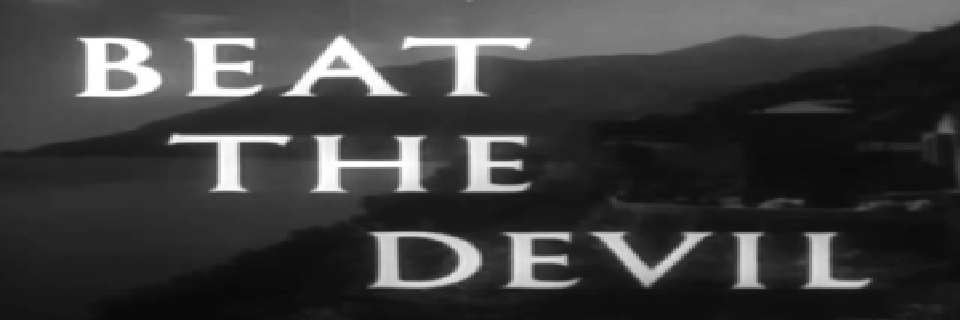
Beat the Devil, directed by John Huston and co-written with Truman Capote, is a wry, offbeat film that defies the conventions of the adventure and crime genres. Released in 1953, it is often described as a parody of the very films it appears to emulate, such as Huston’s own earlier classic, The Maltese Falcon. With a cast led by Humphrey Bogart, Jennifer Jones, Gina Lollobrigida and Robert Morley, the film blends satire, suspense and dry humour into a surreal tale of ambition, deception and absurdity, set against an exotic Mediterranean backdrop.
The story follows Billy Dannreuther (played by Bogart), a down-on-his-luck American expatriate and former playboy, now entangled with a group of dubious businessmen scheming to gain control of uranium-rich land in British East Africa. Billy’s connection to the group is tenuous, born out of misfortune rather than shared interest. His fortunes have dried up, and the wealthy lifestyle he once knew is now a distant memory. His glamorous Italian wife, Maria (Gina Lollobrigida), is aware of his decline, though she continues to cling to the fading charm of his past and the hope of restored prestige.
Billy’s dubious companions are an eccentric and morally dubious quartet: Peterson (Robert Morley), a pompous and verbose Englishman; Julius O’Hara and his wife Gwendolen (Peter Lorre and Ivor Barnard), who pose as respectable but are clearly hiding something; and Major Jack Ross (Marco Tulli), a criminal posing as a former British officer. They present themselves as international entrepreneurs, yet their clumsy scheming and selfish aims suggest little in the way of competence or coordination.
These five would-be adventurers are stranded in the Italian port town of Ravello, waiting for a ship that will take them to Africa where they plan to bribe local officials and secure mining rights to valuable uranium deposits. Their journey, however, is delayed, first by mechanical issues with the vessel and then by layers of bureaucracy, suspicion and farce. This delay becomes central to the film’s structure, allowing a more character-driven narrative to unfold, and drawing attention to the relationships and tensions within the group.
Adding a further twist are the Chelms – Harry (Edward Underdown), a proper and humourless British gentleman, and his wife Gwendolen (Jennifer Jones), who is imaginative, unpredictable and refreshingly uninhibited. The Chelms are staying in the same hotel as Billy and the others, and soon become entangled in the group’s convoluted plans. Gwendolen, with her erratic but captivating manner, quickly forms a flirtatious and ambiguous relationship with Billy, sparking jealousy in Maria and adding a new layer of complication to an already entangled web.
The film plays heavily on mistaken identity, unreliable narration and contradictory motives. Gwendolen fabricates a story in which her husband is a secret agent working for the British government, giving the conspirators pause. In truth, Harry Chelms is a dull and honest man who happens to be interested in East Africa himself, albeit through legitimate investment channels. The gap between perception and reality becomes a recurring theme, and the plot often takes delight in revealing how little any of the characters truly understand about one another.
Huston’s direction favours long, meandering dialogue scenes in which nothing seems to happen, but everything is slowly unravelled. The pacing is deliberately leisurely, reflecting both the Mediterranean setting and the futility of the characters’ aspirations. While much of the dialogue was reportedly improvised on set by Capote and the cast, the result is witty, unexpected and deeply ironic. Characters frequently contradict themselves, engage in illogical plans, or are so self-deluded that they appear comic despite their criminal intent.
Billy, serving as the film’s moral centre by default, is not so much a hero as a man too tired to keep deceiving others, or even himself. He drifts from scene to scene, cynical and world-weary, yet oddly likeable in contrast to the farcical desperation of his companions. Bogart’s performance is relaxed, dry and understated, lacking the hardened edge of his earlier noir roles. His Billy is a man resigned to absurdity, doing his best to ride the current without drowning in it.
Maria Dannreuther and Gwendolen Chelms, while very different in temperament, share a similar position as women bored by their husbands and yearning for excitement. Maria attempts to rekindle the illusion of Billy’s former grandeur, while Gwendolen conjures fantasy after fantasy to give colour to her surroundings. Jennifer Jones in particular brings an eccentric energy to her role, making Gwendolen a figure of both comic delight and narrative unpredictability.
When the group finally sets sail, the journey is short-lived. The ship runs into trouble, and the passengers are rescued and detained by Arab officials, who question their intentions and inspect their backgrounds. While in captivity, the petty alliances among the characters fall apart completely. The group is interrogated, their cover stories unravel, and the supposed criminal masterminds reveal themselves to be bungling fools with more ambition than sense.
Their release is secured not through cunning or bravery but due to the simple incompetence of the bureaucracy. When they finally return to Italy, they find that Harry Chelms has reported their schemes, leading to further embarrassment and collapse of their plans. Yet even in defeat, none of the characters seem to learn or change significantly. Their delusions remain intact, their egos unshaken, and the absurdity of their lives continues unabated.
What makes Beat the Devil so compelling is its refusal to conform to expectations. It masquerades as a noir adventure, only to mock its own genre conventions. The villains are inept, the heroes ambivalent, and the plot more concerned with satire than resolution. The tone is light but sharp, and the script’s dry humour is matched by the cast’s willingness to play against type.
Though initially dismissed upon release, the film has gained appreciation over time for its subversive wit and clever storytelling. Its blend of parody, surrealism and travelogue gives it a distinctive place in cinema history. John Huston’s direction, combined with Capote’s irreverent script and the star power of Bogart and Jones, results in a film that is difficult to categorise, yet rich in nuance and character.